Showing posts with label guatemala. Show all posts

Friday, March 8, 2019

After The Volcano


At the end of our twelve-week stay in Guatemala this winter, we stayed for three days at the lovely Hotel Bambú, nestled in splendid owner-designed gardens on the bay on the edge of Santiago Atitlan. The hotel was founded in the early 1990s by José Ramón de Castro, who originates from Vigo, in Galicia, Spain. As we were departing, two close friends of José were saying their goodbyes after a weekend visit. We were awaiting our tuk-tuk taxi, headed for the lancha to take us across Lake Atitlan to Panajachel, thence by minibus to Antigua. Jose's friends invited us to travel direct to Antigua with them in their Jeep. Perfect - yes please!


Our route took us for our first time on the southern "coastal" road via San Lucas Toliman south along  a well-paved stretch downhill through coffee plantations, majestic trees, and open green grasslands before turning east to Escuintla on a terribly bumpy and potholed divided road reminiscent of Cuba with its vast tracts of sugar cane and associated processing plants. The bustling town of Escuintla reveals more modern dress among the locals than the traditional Mayan costumes we are used to seeing on Lake Atitlan and in Antigua. Having negotiated our way through the busy streets entirely lacking signage, we headed north and up past towering volcanoes on the last stretch, the highway to Antigua. 


With little warning, the otherwise smooth road kinked and became a twisted surface of dusty ash and gravel, a grey moonscape. We were crossing the wide river valley where rainy season torrents bring down heavy precipitation. This landscape has, however, been transformed by the cataclysmic eruption of Volcan Fuego in a massive surging pyroclastic flow over 20 kilometres in length on the morning of June 3 last year. Pyroclastic flows are hot, fast-moving avalanches of ash and rock debris of all sizes, that wipe out everything in their path. The height of the ash plume first rose to an unusual 10+ kilometres, then decreased to 5 - 6 kilometres for most of the eruptive phase. There was no warning of the ferocity and speed of this monumental event. According to our hosts, La Reunion golf course ordered evacuation by 11am. Two towns, El Rodeo with a population of 14,000, and San Miguel Los Lotes 2 kilometres north, did not receive official evacuation orders until 3pm, by which time the damage was already done, the warning too late. Both towns were buried in deep, hot ash. Though official estimates put the death toll at around 300, the fast burial of these towns make it certain that many thousands perished, and salvage efforts continued for many weeks, with survivors desperately seeking their missing loved ones. Witnessing this scene of devastation, with rooftops peeking out above the carpet of grey, with rocks and boulders strewn around, was sobering indeed. Above the valley floor, the land remained completely untouched by this savage onslaught. 


It was good to get back to the civility and charm of Antigua so fast, in such comfort, delivered right to our hotel, having seen a whole new part of Guatemala, and having avoided the schlepping of heavy baggage from taxi to boat to taxi to minibus.

Thursday, February 21, 2019

Cerro de Oro


Chico invited me to climb Cerro de Oro with him, Monday, departing at 5 am, before sun-up, the air fresh and cool.... He duly picked me up, a little late, but ready to head off across the lower slopes and up the mountain, Cerro de Oro, a giant lava dome that towers 330 metres above Lake Atitlan. It was dark when we left with daylight peeking over the crater rim to the east. At first by torchlight, we meandered along paths, mostly ancient, through red-beaned coffee groves and dry-stalked corn fields. The coffee groves are shaded by huge, ancient avocado and jocote trees. Chico has his two dogs and a machete. Farmers we pass have just machetes and greet Chico in Kaqchikel, *xseqër k'a!*,then me in Spanish. *"Buenos dias!"* As the sun appears over the horizon behind us, we see Cerro de Oro bathed in orange dawn light up ahead. The mountain is steeped in Mayan mythology; legend involves an elephant, a serpent, and a giant. One legend continues that Antoine de Saint-Exupéry came to Lake Atitlán where he saw Cerro de Oro: the “hill of gold” became the model for “the boa constrictor digesting an elephant” on the first page of The Little Prince. He said when the Spanish first came to Lake Atitlán, they looked for gold hidden by the Maya in the caves and tunnels under the hill where they became lost and never returned. Other legends say the tunnels run all the way to Tolimán volcano, and that the Tz’utujil people hid from the Spaniards in the tunnels. The colossal steeped mound has the look of a crouching beast with a bristling head, lit up now in its fiery morning glow.


And a beast she was to climb. Not that high, but steep, on very dusty narrow trails, with sheer drop-offs down arid, dry-season-denuded slopes. At a cluster of massive boulders which serve as a ceremonial altar, the slope eases, winding like the snake around a wooded glade to the rocky, treed summit. The views are magnificent over Lake Atitlan, from Santiago, to San Pedro, to Panajachel, all the way round to San Antonio. The air is hazy; the sun glistens over the little peninsula of Pachitulul, where we have come from, way down below. The morning sounds of traffic and activity from the strung-out village of Cerro de Oro drift up on the pleasant breeze. At 8 am, the sun is already hot and our time of rest, re-hydration and contemplation is most welcome. Chico tries to assure me that this climb is good for the heart, legs, and soul. To him, the elephant swallowed by a boa constrictor seems sacred and hallowed. 


His world stretches before us - Lake Atitlan in all her glory. He says that when he was a youngster, the lake lapped at the feet of the now giant amate tree at Casa Pitaya where we regularly sit on a hillock with the lake some thirty feet below! The fields he farms today were, back then, under water and this whole shoreline is reclaimed. He says the lake level goes up and down in 45-year cycles, suggesting that another rise is due. As we gaze from this eagle's nest some 1100 feet above the lake, anywhere near a thirty foot rise over the breadth of this vast expanse of water seems unthinkable, but the twenty five feet drop in recent years is indicative of the possibility. It would certainly upset more than a few foreigners who have built homes and businesses perched close to the water's edge. The locals know better, of course.


Back home, a refreshing swim in the tranquil waters of the bay washes away the dust of the trail. Later on, Chico cut a fabulous bunch of a dozen ripe bananas and delivered them. A fruit salad of fresh-picked bananas and lemons, with sweet pineapples and mangoes from the market drizzled with local mountain honey was so juicily delicious.

Saturday, February 9, 2019

San Lucas Toliman, revisited


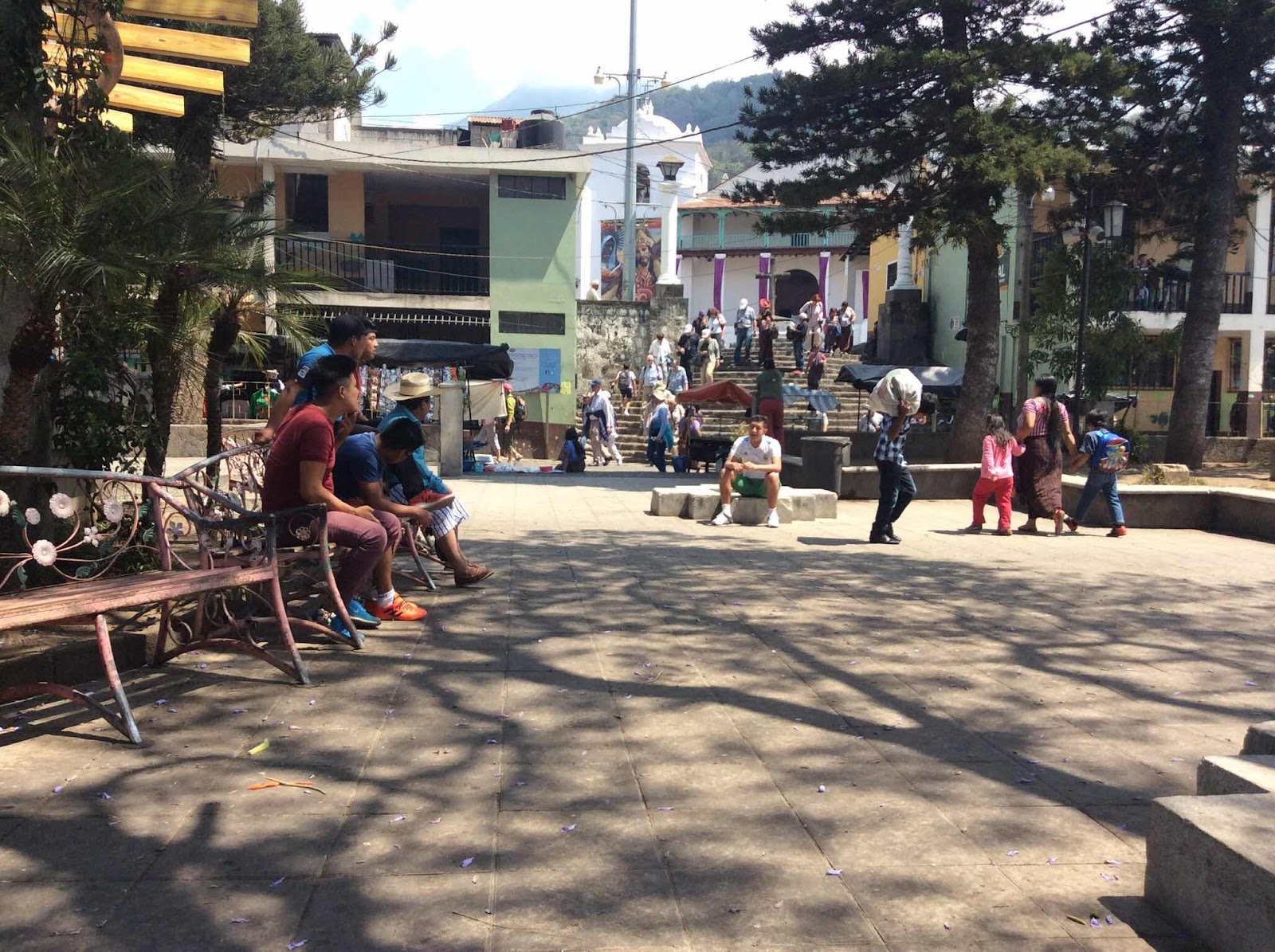
Market days are Tuesday, Friday, and Sunday. On these days, several streets are closed to traffic and thronging with vendors, their produce, and customers. The vibrant colours of Kaqchikel Mayan women in their *trajes* and the fruit and vegetables on offer, comined with the hubbub of banter create a boisterous and lively atmosphere. A large proportion of this food is locally-grown on small plots of land and brought fresh to market. We have never experienced anywhere else the depth of intense flavour of the beets and carrots, mangoes and melons of the markets around Lake Atitlan.


On non-market days, these same streets look desolate and unkempt. Any number of *tiendas* sell mostly packaged junk food in a sea of plastic. Any number of *farmacias* sell pharmaceutical drugs, largely to medicate and treat against this junk diet. Sugary carbonated drinks and salty snacksy made using industrial-strength glyphosated GMO corn and soy doused in unhealthy trans-fats help to fuel malnutrition, obesity, and diabetes rates.


The view from Hotel Toliman, towards San Antonio Palopo


Apart from a handful of hotels, including the lovely Hotel Toliman, this town of 17,000 inhabitants, 90 - 95% of them Mayan, barely caters to tourists and travellers at all. One cafe, Cafe Jade, offers free wifi and freshly-ground coffees. The restaurants and fast-food eateries in town service mainly locals. Hotel Toliman sits on a knoll overlooking a swimming pool, beautiful gardens, the bay and the open waters of Lake Atitlan beyond. The far view takes in San Antonio Palopo on the shore and Agua Escondida further along, up on the crater rim. The accommodations look delightful and the cuisine is sumptuous, making full use of fresh ingredients from their one-acre organic garden, fresh fish, and 100% grass-fed beef. What could eclipse this?


Tuesday, February 27, 2018

The Future of Lake Atitlán


As I look out this bright mid-afternoon in this middle of the dry season, Lake Atitlán is in its gloriously shimmering element, all abuzz with dancing movement and vibrant light. As is normal, the winds swept a front across the lake south west to north east around noon, erasing the calm serenity of the morning. Whenever at the lake, I like to take a swim, straight off the dock if possible, bathing in the clear cobalt-blue waters, with the deep blue sky reflected on the surface. 


It would be nice to think that the pristine-looking waters of this mesmerizing 1,100-foot deep caldera lake will always remain as clear and clean as they have been historically. But sadly, Lake Atitlán already faces immense ecological pressures.


Bacteria counts are on the rise, especially at certain pressure points, where effluent of sewage and chemicals enter into the lake in increasing volume. Water quality is continuously monitored and anaysed by organizations such as Amigos de Atitlán (www.amigosatitlan.org),  AMSCLAE (www.amsclae.gob.gt), the government authority for the sustainable management of the lake basin of Atitlán, and Save Lake Atitlan (www.savelakeatitlan.com).


Amigos de Atitlán reports: "After years of contamination, the lake has presented signs of severe environmental stress."

"The lake is going from oligotrophic – crystalline and potable waters - to mesotrophic – turbid and green – and if this degradation continues it will go on to become an eutrophic lake impossible to recuperate."

"The principal threats that must be addressed in short term are:

Sewage water

The use of the soil, which includes three principal factors: the expansion of the agricultural frontier, erosion, use of fertilizers, and use of agro chemicals.

Solid waste"


"AMSCLAE, the authority responsible for the protection of Lake  Atitlán presented in 2015 an initiative to develop a Master Plan for drinking water supply and wastewater treatment. This plan includes technology options, institutional framework and community consultations for the introduction of drinking water supply, sewerage and sewage export outside the Basin. Wastewater treatment plants installed in some municipalities are only part of the solution, treatment plants alone fail to remove pathogens and nutrients such as nitrogen and phosphorus that feed the cyanobacteria."

"Since the start of the Master Plan development, Amigos de Atitlán allowed for dialogue and has spread information of the plan at a national level. The association has gained support at all levels to stop wastewater from entering the lake. Additionally Amigos de  Atitlán has promoted the comprehensive drainage system as the only feasible economic and environmental solution to preserve and restore Lake Atitlán."


Raw liquid sewage draining into the lake


savelakeatitlan.com reports:

"There are not enough wastewater treatment plants around Lake Atitlán to treat the ever-increasing amount of raw sewage produced by the area’s growing population. Most of the existing plants operate well below full capacity. They simply remove solids and do little to reduce the volume of pathogenic bacteria entering the lake. Only one of many planned new facilities has been built so far, and municipal authorities do not have the resources they need for maintenance and upgrading.

As a result, thousands of metric tons of raw sewage or improperly treated wastewater from households and businesses in more than 20 towns enter the lake each year. The ecosystem is under constant siege from putrefactive bacteria and other pathogens."

"Since the 1950s, local farmers have been pressured to abandon natural farming and instead use chemical fertilizers, pesticides, fungicides, and herbicides. These toxic products are highly subsidized, and poor farmers are strongly encouraged to use them copiously to boost their production. The fertilizers, which are particularly high in phosphorous, run off into the lake during the rainy season. Waste water from coffee processing is also acidic and high in natural effluents." 

"Lake Atitlán is a ‘Protected Area’ under Guatemalan law, but commercial tilapia farms are being allowed to operate on a massive scale, even though all the nutrients that they leave in the lake are accelerating the destruction of the lake’s ecosystem."


A perennial problem is the lack of consensus as to how to proceed that often leads to paralysis, inertia, foot-dragging. Locals are understandably reticent to throw support behind large infrastructure projects, given the checkered history of granted funds being utilized as mandated. And where does the funding come from? How much control will municipalities and communities have over their own precious and finite resource - water? Who 'owns' the project? The future fate of the lake is far from clear, but bold concerted action from all stakeholders is called for.

Saturday, February 17, 2018

San Lucas Tolimán


San Lucas Tolimán


Our visit to all twelve towns and villages around Lake Atitlán is now complete. And we think that with the last on the list we have found our Shangri-la! After Panajachel, San Pedro la Laguna, San Juan la Laguna, San Marcos la Laguna, Santa Cruz la Laguna, Jaibalito, Tzununá, San Pablo la Laguna, Santiago Atitlán, Santa Catarina Palopó, San Antonio Palopó, we finally disembarked the lancha at the tranquil backwater of San Lucas Tolimán. What a magical day we spent there!


It was like a dream - Sunday in the Country meets Picnic at Hanging Rock. We took advantage of a new 3-times daily public boat service, departing Panajachel at 8.30am, returning from San Lucas Tolimán at 4pm. The cost of the half-hour trip (for, sadly, just three passengers each way), was 20 quetzals, or $3, each.


As our boat rounded a headland, we left the open waters of Lake Atitlán behind and entered a bay with clear blue water, flooded tree trunks and weedy rim. The park that takes up the waterfront is shaded by big trees and lined with thatched bars serving simple fare and beer. Tuk-tuks were conspicuously few and the locals, while exceptionally friendly, are not perturbed by stray visitors. The whole town is paved with broad streets. A walk up the hill takes us to the vibrant central square. Off to our side are several streets taken up by the twice-weekly market. The vendors are mostly women dressed in an bright array of traditional weavings and offering their family's fruit, vegetables, flowers, meats, fish, dried goods, eggs, cheese, weavings, carvings, and household utensils. The scene is lively and convivial and, even as rare tourists, we cause no undue attention beyond welcoming banter. We asked a couple of locals for a place for a good coffee and they directed us to the sweet little Cafe Jade, which served the best lattes, 'fuerte' as requested.


After sidestreet meanderings taking in several species of tropical trees in extravagant bloom, we strolled down the hill to the tiled-roofed communal outdoor lavadero, where many women were doing their laundry, using water channeled from the mountains, in ancient large concrete basins. The grey water is filtered through sand catchments before draining into the bay. A crew of men was hauling out thick weed mass from the bay, piling it up for removal and making into compost. With wet, cold hand outstretched, Marlon introduced himself. Out around the bay, the pavement finally gave way to dirt. Here a quiet, mixed community of homes from the grandiose to the humble sits quietly looking out over the water. Small coffee plantations grow shaded by banana trees, single farmers prepare and plant fields of corn, beans, peppers, tomatoes, celery. We decided we could quite happily live here, cultivating our own little backwater just outside this pueblo, with a small self-sufficient garden beside our simple home, making our way into market to purchase fresh local organic goods, with a boat ride to Pana once week to top up on supplies. On our way back into town Marlon and a mate awkwardly asked for 10 quetzals (75 cents) to buy tortillas as they were hungry.


Having worked up a hearty appetite, it was time to visit the elegant Hotel Tolimán (www.hoteltoliman.com). Set in beautiful landscaped gardens, the hotel offers luxuriant accommodation with local character. The kitchen makes full use of the most complete and impressive organic market garden that takes up half an acre adjacent to the hotel. The views over the bay and lake beyond from the covered terrace dining room are jaw-dropping. Our prix fixe three-course lunch, which included a day pass for swimming in the pool and a tour of the market garden, was very reasonable at  150 quetzals ($20) per person. The food and drinks were fresh, delicious, tastefully presented, and service from our server Lionel came with a smile and affable chat. This was a fine dining experience.


Back to the waterfront to await our return boat, we passed a beach designated for boats, another for baptisms, and another for bathing. Bathed in afternoon sun, teenagers, girls and boys, stripped down to shorts and swimsuits and joyfully, loudly dived in. A young couple doffed tops to splash around playfully and wash hair and body, innocently oblivious to the world around. 


And then our boat launched us three passengers back onto the open waters, across the volcano-rimmed lake, out of daydream, back to Panajachel, thence onward home on a second boat, this one crammed full and heavy with well over twenty tourists, luggage, and locals, sprayed liberally with water on a choppy ride. We feel blessed to have enjoyed this memorable travel day soaking up such a rare traditional, vibrant, happy culture set in harmonious surroundings. 

Sunday, January 28, 2018

Water has escaped...

waterfall cascada atitlan guatemala maya

"Water has escaped the rocky prisons of the Moon's springs in the Mountain Stronghold of the Sun's sky, and in love with the sparkle of the Ocean, seeps secretly through the Mountains, gathering in hopeful streams, to rush as a long swollen river to the Ocean, where dismembered by the electric heat of the sky, she lives on in a massive diversity as all the world's plants, whose tree and plant breaths become the clouds carried on the back of the Southern Hummingbird Wind back to her origination in the mountain lake. Inside the pot (the lake) under the Moon's bed  (the night sky) she is then "cooked" like the wild greens that the Mayans love and depend on daily for their food, and it is here that water finally goes from plant form to become all the animals hatched from eggs and born from wombs."

Martin Prechtel, The Disobedience of the Daughter of the Sun